County Budget & Financial Information

Banner with water fall scene and budget series info

Understanding the Annual County Budget Process

A plain-language guide to how Tompkins County plans, funds, and delivers services

County Budget Explainer

Every year, Tompkins County develops a budget that guides how public dollars are invested to provide the services our community relies on every day. From public health and emergency response to elections, road maintenance, mental health services, support for older adults, and many other programs, the County budget reflects the resources needed to serve our community while balancing changing needs and financial realities.

Budget documents often contain technical terms, financial data, and government processes that can be difficult to understand. At the same time, budget decisions affect every resident, making it important that everyone has the opportunity to understand how those decisions are made.

To help make the budget process more accessible, Tompkins County is launching Understanding Your County Budget, a four-part series that explains the County budget in plain language. Each week, we'll explore a different aspect of the budget process, answer common questions, and explain key concepts to help residents better understand how County government plans for the year ahead.

Over the next four weeks, we'll cover:

  • Week 1: What does Tompkins County do, and who pays for it?
  • Week 2: Why is building the County budget so challenging?
  • Week 3: How is the County budget built?
  • Week 4: What is the Property Tax Cap, and what happens on September 1?

After the County Administrator presents the Recommended Budget on September 1, we'll continue the series with a guide to understanding the proposal and following the Legislature's Expanded Budget Committee (EBC) meetings, where the budget is reviewed in public before it is adopted.

Whether you're following the budget for the first time or simply want a better understanding of how County government works, we hope this series provides useful context and encourages you to stay informed throughout the budget process.

County Budget Basics #1: What does Tompkins County do, and who pays for it?

Every day, Tompkins County provides services that help keep our community healthy, safe, and connected. Some of these services are highly visible, like elections, road maintenance, or emergency response. Others happen behind the scenes but are just as essential, from inspecting restaurants and protecting public health to helping older adults remain independent, supporting veterans, administering public assistance programs, and coordinating mental health services.

Because County government works alongside the State of New York, local municipalities, school districts, and many community organizations, it isn't always obvious which level of government is responsible for which services. Understanding what the County does is the first step toward understanding how the County budget works.

What happens to your property tax dollar?

When you receive your property tax bill, it's easy to assume it all goes to one local government. In reality, your property tax bill is shared among several taxing jurisdictions—including your school district, municipality (city, town, or village), and Tompkins County. The exact breakdown varies depending on where you live.

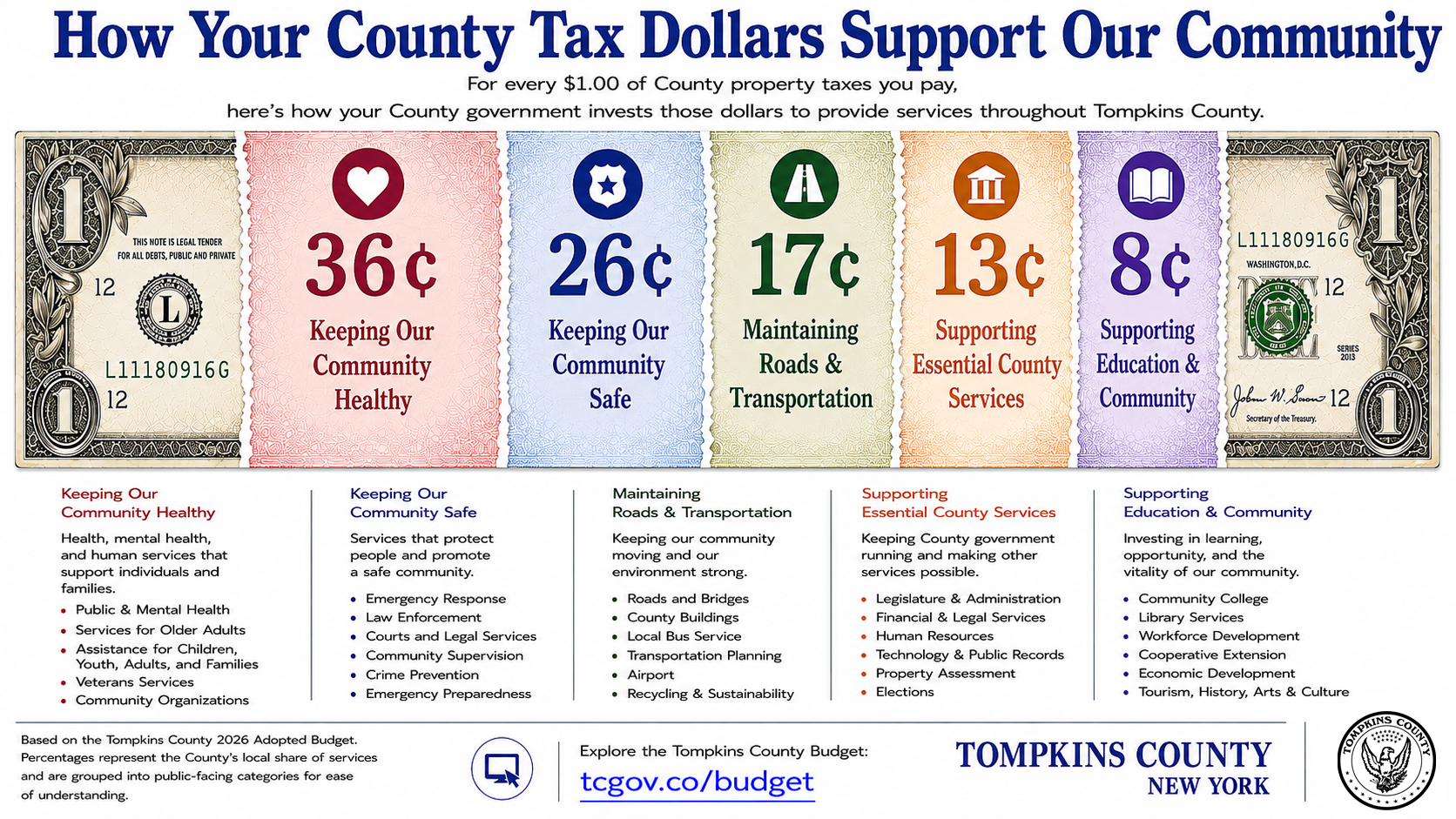
The first two graphics use the City of Ithaca and the Town of Newfield as an example to show how a typical property tax dollar is divided among the school district, city/town, and county. The third graphic shows how Tompkins County invests its share of that dollar to provide services that residents rely on every day.

Together, these graphics help answer two common questions:

  • Who receives my property tax dollars?
  • What does Tompkins County do with its share?

Examples shown are based on 2026 adopted budgets and tax rates and are intended to illustrate how property tax dollars are distributed and invested. The exact distribution among school districts and municipalities varies depending on where you live in Tompkins County.
Property Tax Bill Broken Down City of Ithaca


Property Tax Bill Broken Down Town of Newfield.png


County Tax Dollar broken up to show what it pays for

What does County government do?

Tompkins County delivers a broad range of services that residents rely on every day. These include:

  • Public health and disease prevention
  • Mental health and addiction services
  • Emergency medical services coordination
  • Social services and child welfare
  • Youth development programs
  • Office for the Aging programs
  • Elections and voter registration
  • Probation services
  • Highway and bridge maintenance
  • Recycling and materials management
  • Planning and economic development
  • Veterans services
  • Emergency preparedness and response
  • Law enforcement and criminal justice
  • Airport

Many of these services are provided because New York State requires counties to administer them locally. Others reflect priorities established by the Tompkins County Legislature in response to community needs.

Where does the money come from?

One of the biggest misconceptions about County government is that property taxes pay for everything. In reality, the County relies on several revenue sources to fund services.

County revenues include:

  • Property taxes
  • Sales tax
  • State aid
  • Federal aid
  • Grants
  • Fees for certain services
  • Other local revenues

Approximately 21% of County revenue comes from property taxes, while the remaining 79% comes from these other sources.

Each revenue source plays a different role. For example, grants may only be used for specific programs, State and Federal aid often support required services, and sales tax revenue helps reduce the amount that must be raised through property taxes.

Because these revenue sources can change from year to year, the County must carefully monitor economic conditions, State and Federal funding decisions, and local trends while developing each annual budget.

Why does this matter?

The County budget is more than a financial document. It is a plan for delivering services that residents depend on every day. Understanding what the County does and how those services are funded makes it easier to understand the choices that must be made during budget season.

Did You Know?

Tompkins County provides services through approximately 30 departments and agencies and employs approximately 850 people who serve residents every day.

Myth vs. Fact

Myth: Property taxes pay for the entire County budget.

Fact: Property taxes are only one source of County revenue. Sales tax, State and Federal aid, grants, fees, and other revenues all help fund County services.

Budget Basics

Revenue
Revenue is the money the County receives to pay for services. It comes from several sources, including property taxes, sales tax, grants, fees, and State and Federal aid.

General Fund
The General Fund is the County's primary operating fund. It supports most day-to-day government services, including public safety, health, administration, and human services.

What's Next?

Next week, we'll look at why building the County budget is more complicated than simply deciding how much to spend. We'll explain the difference between State-mandated services and locally funded programs, and explore the major factors that influence the County's budget each year.

Have a question about the County budget?
Send it our way! Throughout this series, we'll answer selected questions from residents in our Resident Question of the Week feature. Submit your question on our 2027 Budget Feedback Portal.

Follow along each week on the Tompkins County website and social media as we explore how the County budget supports the services, infrastructure, and programs that help make Tompkins County a healthy, safe, and thriving community.


2027 Budget Retreats

Special Funds Distribution

American Rescue Plan Act (ARPA)

On March 11, 2021, President Biden signed the American Rescue Plan Act of 2021 (ARPA), a $1.9 trillion economic stimulus package designed to help the U.S. economy recover to pre-pandemic levels. Tompkins County received $19,847,267 in State & Local Fiscal Recovery Funds (SLFRF) to support households, small businesses, and communities most impacted by COVID-19.

A significant portion—42.46% or approximately $8.43 million—is allocated to Capital Projects, the largest category. Government Services accounts for 20.77%, reflecting a strong commitment to public service. Non-Profit organizations receive 19.52%, primarily distributed through the Community Recovery Fund program, underscoring efforts to enhance community services. Health and Human Services is allocated 12.51%, supporting initiatives for homelessness, mental health, and substance abuse. Additionally, nearly $400,000 is designated to support agencies focused on agriculture, food security, serving vulnerable populations, and emergency response.

For local leaders and residents, these allocations highlight key priorities that may shape the county’s future well-being and development. Monitoring the impact of these investments will be crucial to ensuring they achieve their intended goals.

View the ARPA Fiscal Recovery Funds Dashboard for Tompkins County.

Opioid Settlement Fund Community Projects

In 2025, New York State amended Section 25.18 of the Mental Hygiene Law to increase transparency around the use of Opioid Settlement Funds. These funds are distributed through two primary streams: Restricted Direct Spending and State-Administered Funding.

Restricted Direct Spending refers to funds allocated directly to counties and cities to support local initiatives focused on prevention, treatment, recovery, and community-based responses to the opioid crisis. 

State-Administered Funding is managed by New York State agencies and supports programs that align with these same goals through Local Government Units (LGUs), such as Tompkins County Whole Health.

In Tompkins County, the City of Ithaca and the Local Governmental Unit (LGU) have combined their respective allocations to support the A Place to Stay housing initiative.

The Opioid Settlement Fund Community Projects web page provides information on how Tompkins County has utilized its Restricted Direct Spending and LGU funds to address the impacts of the opioid crisis within our community.


Prior Year's Budget Documents

2026 Budget Process Documents

2026 Online Budget Book

2026 Recommended Budget Book (PDF)(PDF, 38MB)

  • In the recommended budget, the county administrator delineates for each department which enhancement requests could be supported and which ones could not due to fiscal constraints.

  • Departments and agencies can detail these requests during presentations to the Expanded Budget Committee (EBC), and they are for the legislature to consider when voting on the budget. Any increases to the recommended budget, if not offset by reductions in other areas, will result in a tax levy increase.

Highlights of the 2026 recommended Tompkins County budget as prepared by the county administrator:

The proposed total property tax levy is $57 million, which is $2.5 million, or 4.5%, higher than in 2025.

  • If passed, this would result in a 4.5% tax levy increase and a $37 increase in the property tax bill for the owner of a median-priced ($300,000) home.
  • The recommended operating budget totals $240 million, with revenues comprising primarily of local property taxes (levy), sales tax receipts, and state and federal funding.

Expanded Budget Committee (EBC)

  • Highlights of the EBC meetings, especially the voting sessions, focus on enhancement requests or significant changes proposed by departments, agencies, and legislators during the budget process. In addition to these discussions, the legislature can also add or reduce programs that are not included in the county administrator’s recommendation. 

Public Feedback

July 2025

April 2025


2021 Budget Process Documents