Highlights of the 3/3/26 Tompkins County Legislature meeting
Published on March 10, 2026
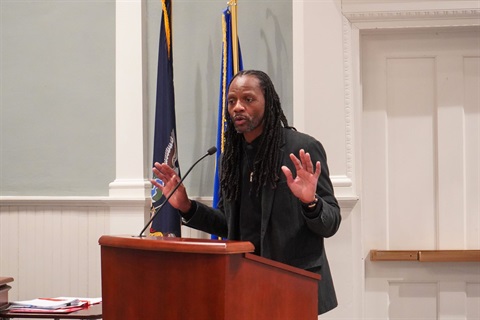
Topics included:
- Chief Equity and Diversity Officer appointed
- Center of Government size and budget reaffirmed
- Easement for EV charging infrastructure at the airport
- Emergency services dispatcher recognized for 37 years of service
- Department of Assessment moving to Lansing
Legislature confirms new Chief Equity and Diversity Officer
The Legislature unanimously confirmed the appointment of Leon Holden (pictured on the right) as Tompkins County’s new Chief Equity and Diversity Officer (CEDO) following a national search. County Administrator Korsah Akumfi stated that the interview panel recommended Holden after a competitive process, and the appointment was brought forward for legislative confirmation as required by the County Charter.
Legislator Pillar (D-Ithaca City) reflected on how the role has evolved alongside the county’s equity framework. “The resolution says that Leon Holden is qualified to perform the duties and responsibilities of the position, but it’s more than that. You’re the right person for this position at this time, and we are excited to get going,” Pillar said.
Holden thanked the Legislature for the opportunity and emphasized his commitment to supporting both county leadership and the broader community. Reflecting on his career path, he described equity as a shared responsibility to uplift others. “That’s what equity means to me — that we’re all here to support each other beyond race, ethnicity, gender, age, or geography. Our job is to support each other and the community, and that’s what I’m going to show up and do every day,” Holden said.
The Chief Equity and Diversity Officer leads the county’s efforts to advance organizational equity, implements the county’s equity framework and indicators, and helps integrate those principles across departments and services.
Center of Government project size and budget reaffirmed
As requested by the legislature, county administration presented two scenarios for the Center of Government project. The discussion largely centered on two main building sizes: a larger option with approximately 57,000 square feet and a smaller version with roughly 37,000 square feet. The building size is driven primarily by departmental space needs and the goal of consolidating county operations currently spread across multiple buildings and leased spaces.
Staff described the smaller building as a reduced consolidation option, which would house about 105 employees and only some county departments. Other staff would remain in existing county buildings or leased spaces. The county would need to reconfigure the Daniel D. Tompkins Building and the Old Jail to accommodate displaced departments. Some legislators saw this option as a compromise that reduces upfront costs, but it would not fully solve the county’s long-term space needs.
The larger option reflects the original goal of the project: consolidating more county departments into one facility. Designed to accommodate around 13–14 departments, it includes a 20% growth factor (roughly 20 additional workspaces across departments for future staffing changes). This option is intended to reduce dependence on leased space and provide long-term flexibility. Some legislators argued the larger building would better address the county’s needs over the next 40–50 years, rather than forcing future legislatures to revisit the same issue.
Legislators explored why the smaller building appeared more expensive per square foot. HOLT Architects explained that site preparation and infrastructure costs remain largely fixed, regardless of building size. As the building shrinks, those fixed costs are spread across fewer square feet, increasing the per-square-foot cost.
Staff also emphasized that continuing to lease space exposes the county to market rent changes and loss of control. Owning a consolidated building provides predictability and long-term cost stability.
Legislators in support of the larger building argued the county should build a facility large enough to fully house county government functions, avoid continued reliance on leased office space, and plan for long-term growth and operational flexibility.
Others favored the smaller option due to budget constraints and taxpayer impacts, uncertainty about other major capital projects (jail, EMS, housing programs), and concerns about increasing county debt and tax levy pressures. Some legislators felt it would be irresponsible to commit to the larger project without clearer forecasts for other upcoming expenses.
Both resolutions failed, and the legislature defaulted back to the previously adopted resolution from 2025, which authorized a Center of Government project of about 45,000 square feet with a cap of up to $50 million, including related renovations to other county buildings.
Easement for EV charging infrastructure at the airport approved
The legislature approved a resolution authorizing the county administrator to sign an easement with New York State Electric & Gas (NYSEG) to allow installation of a transformer needed to support two Direct Current Fast Charging (DCFC) dual-port Electric Vehicle (EV) charging stations on county-owned land near Ithaca Tompkins International Airport. County staff explained that the 10-by-10-foot easement is required for NYSEG to deliver electricity to the chargers, which will be installed and operated by a private partner at no cost to the county, while providing the airport with a 5% share of charging revenue.
Supporters emphasized the need for additional EV charging infrastructure and the relatively small footprint of the easement. Legislator Brown (R-Newfield, Enfield) noted the broader benefit to the community, saying, “This is a real asset for people visiting the airport, and it’s a little bit of revenue. I think it’s the right thing to do.”
Opponents supported EV charging but objected to granting a perpetual easement to the utility without the ability to revoke it in the future. Legislator Mezey (D-Dryden), “I just fundamentally have an issue encumbering county land without an ability to revoke… I think NYSEG needs to hear the message that they don’t get to set the rules.”
An attempt to send the resolution back to the committee and another proposal to require a revocable easement both failed. The legislature ultimately approved the resolution by a 13–3 vote (Legislators Mezey (D-Dryden), Weiser (D-Caroline, Danby), and Sigler (R-Lansing) opposed).
Other business
The legislature recognized long-time emergency services dispatcher, Lauren Dickenson, for this almost 37 years of service to Tompkins County and wished him all the best in his retirement.
The Department of Assessment will start its move to 31 Dutch Mill and will be available to the public at this location starting March 16.
The legislature unanimously approved a resolution that establishes a Human Rights Programs Manager position within the Tompkins County Office of Human Rights, placing the office administratively under county administration to coordinate education, outreach, intake and referral services, and support for the Human Rights Commission. It also directs that the structure of the office and the director position be reevaluated after one year and reaffirms the county’s commitment to maintaining accessible local human rights services and community partnerships.
The legislature, in a proclamation, designated March 8, 2026 as Volunteers of America Day in Tompkins County. This year marks the 130th anniversary of its founding in 1896, honoring a rich history of service, most recently as operators of the county’s Code Blue shelter.
How to stay engaged